


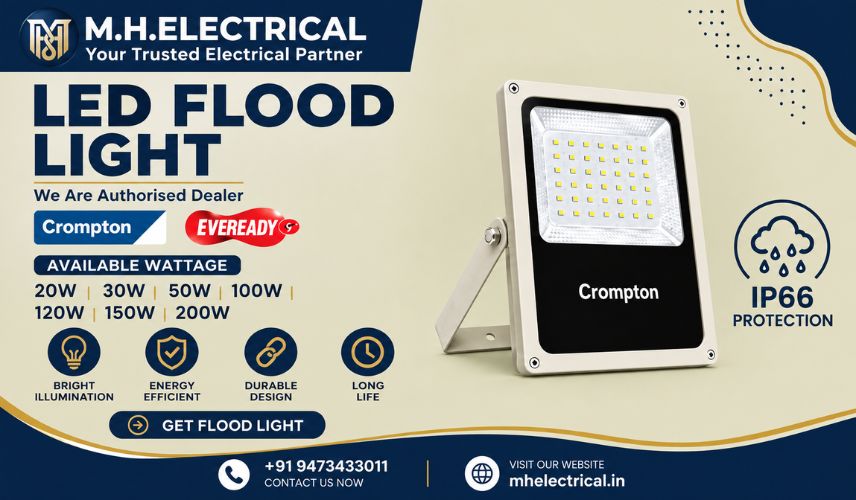
Choosing the Best LED Flood Light for Efficient Illumination
Outdoor and industrial spaces require dependable lighting to maintain visibility, safety, and functionality after sunset. From residential entrances and gardens to warehouses, factories, parking areas, commercial buildings, and large outdoor spaces, proper illumination can make a major difference. LED flood lights have become a preferred lighting solution because they offer powerful illumination, energy-efficient operation, durable construction, and long-lasting performance.
Choosing the best LED flood light, however, requires more than simply selecting a fixture with a higher wattage. The right product should provide sufficient brightness, suitable beam coverage, reliable electrical performance, effective heat management, and protection against environmental conditions. Understanding these factors makes it easier to select a flood light according to the specific requirements of the installation.
What Makes an LED Flood Light the Best?
The best LED flood light is one that provides the right balance between illumination, efficiency, durability, coverage, and reliability. Since lighting requirements vary from one location to another, a product that works well for a residential entrance may not be suitable for a factory, warehouse, or sports ground.
High Lumen Output
Lumen output is one of the most important specifications to consider when selecting an LED flood light. Lumens indicate the total amount of visible light produced by a fixture. A suitable lumen output ensures that the required area receives adequate illumination.
Instead of judging brightness only by wattage, buyers should compare the lumen output and luminous efficacy of different products. A highly efficient LED flood light can provide strong illumination while consuming less electrical power.
Energy-Efficient Performance
Energy efficiency is another major advantage of LED lighting technology. LED flood lights can provide high levels of illumination with relatively low power consumption compared with many traditional lighting solutions.
For commercial and industrial installations where lights may operate for extended periods, choosing an energy-efficient flood light can help reduce electricity consumption and operating expenses over time.
Durable Construction
An LED flood light installed outdoors must withstand different environmental conditions. Rain, dust, moisture, heat, and temperature variations can affect lighting equipment if it is not properly protected.
A robust housing, quality components, and effective thermal management can contribute to dependable performance. Aluminium construction is commonly used in flood lights because it offers durability while supporting heat dissipation.
Important Specifications to Check Before Buying
Understanding the technical specifications can help buyers identify a suitable LED flood light rather than choosing a product based solely on appearance or wattage.
IP Rating
The IP rating indicates the level of protection provided against solid particles and water. This is particularly important for outdoor flood lights because the fixture may be exposed to rain, dust, and moisture.
A suitable IP-rated LED flood light can offer better protection in demanding environments. The appropriate rating should be selected according to the installation location and level of environmental exposure.
Beam Angle
Beam angle determines how widely the light spreads from the fixture. A narrow beam concentrates illumination over a smaller area, whereas a wider beam distributes light across a broader area.
For parking spaces, building exteriors, and open outdoor areas, a wider distribution may be useful. For applications requiring concentrated illumination over a particular zone, a narrower beam can be more suitable.
Colour Temperature
Colour temperature affects the appearance of the emitted light. LED flood lights are available in different colour temperatures, including warm white, neutral white, and cool white.
Cooler light is often preferred for industrial areas, security lighting, parking spaces, and outdoor applications because it can provide a clear and bright visual environment. The appropriate colour temperature should ultimately depend on the application and desired appearance.
Colour Rendering
Colour Rendering Index, or CRI, indicates how accurately a light source reveals the colours of objects. A suitable CRI can be important in applications where colour identification and visual clarity are required.
The required CRI depends on the environment. General outdoor lighting may have different requirements compared with commercial, architectural, or specialised applications.
How to Choose the Correct Wattage?
Wattage indicates the electrical power consumed by an LED flood light, but higher wattage does not automatically mean better performance. Selecting the correct wattage requires consideration of the size and purpose of the area.
Important factors include:
- Area that needs illumination
- Mounting height
- Required brightness
- Beam angle
- Distance between fixtures
- Surrounding lighting conditions
- Desired illumination uniformity
- Operating hours
Low-Wattage Flood Lights
Lower-wattage LED flood lights can be suitable for smaller areas such as entrances, pathways, gardens, residential compounds, and small commercial spaces.
High-Wattage Flood Lights
Higher-wattage flood lights can be used for larger areas where greater light output is required. Warehouses, factories, large parking areas, sports facilities, and expansive outdoor spaces may require higher-output fixtures.
The correct selection should always be based on the actual lighting requirement rather than wattage alone.
Best LED Flood Light for Different Applications
Different applications have different lighting requirements, so the best LED flood light depends on where it will be installed.
LED Flood Light for Residential Areas
Homes can use flood lights for gardens, driveways, terraces, entrances, boundary walls, and security areas. A compact and energy-efficient fixture with suitable brightness and weather protection can provide reliable illumination.
Proper positioning is important to ensure that the light covers the intended area without producing unnecessary glare.
LED Flood Light for Parking Areas
Parking areas require good visibility across vehicle movement zones and pedestrian pathways. A suitable beam angle can help provide broader and more uniform illumination.
Mounting height and fixture positioning should also be considered because these factors influence how effectively the light covers the parking area.
LED Flood Light for Warehouses
Warehouses often have large floor areas and high mounting heights. Therefore, lighting fixtures need to provide sufficient illumination and dependable performance for extended operating periods.
Energy efficiency, beam distribution, thermal management, and electrical reliability are important considerations when selecting LED flood lights for warehouse applications.
LED Flood Light for Factories
Industrial facilities can expose lighting fixtures to dust, heat, vibration, and long operating hours. A durable LED flood light with suitable protection and robust construction can be a practical choice.
The fixture should be selected according to the environmental conditions and lighting requirements of the factory.
LED Flood Light for Sports Grounds
Sports grounds require consistent illumination across the playing surface. Beam angle and mounting position are particularly important because uneven lighting or excessive glare can affect visibility.
For larger sports areas, professional lighting planning is recommended to determine the required number, wattage, mounting height, and positioning of flood lights.
LED Flood Light for Building Exteriors
Flood lights can also be used to illuminate building walls, entrances, commercial premises, signs, and surrounding areas. In these applications, appearance, colour temperature, beam distribution, and mounting flexibility can be important alongside brightness.
Why Heat Dissipation Is Important
Heat management plays an important role in the long-term performance of an LED flood light. LEDs and electronic components generate heat during operation, and excessive temperatures can affect component performance and reliability.
A well-designed housing and heat sink can help transfer heat away from the LED and driver. Aluminium housings are frequently used because of their ability to support effective thermal management.
When selecting a flood light for demanding applications, buyers should consider the construction and thermal design rather than focusing only on lumen output.
Electrical Performance and Protection
Reliable electrical performance is another important characteristic of a quality LED flood light. Specifications such as power factor, input voltage range, surge protection, and driver quality can influence overall performance.
Power Factor
Power factor indicates how effectively electrical power is utilised by the lighting system. A good power factor can be particularly beneficial for commercial and industrial installations where multiple flood lights operate simultaneously.
Surge Protection
Electrical surges can potentially damage sensitive electronic components. LED flood lights equipped with suitable surge protection can offer additional protection against voltage disturbances.
For outdoor and industrial installations, checking the available surge protection specification can therefore be useful before purchasing.
Installation and Maintenance
Correct installation is essential for achieving the expected performance from an LED flood light. The mounting position, height, angle, wiring, and power supply should be properly planned.
Electrical connections should be handled by a qualified professional to ensure safe installation. Incorrect wiring or unsuitable mounting can affect the performance and safety of the lighting system.
Maintenance is generally simple. Periodic cleaning of the external lens or glass can help maintain light output, especially in dusty environments. Connections and mounting arrangements can also be inspected periodically to ensure that the fixture remains secure.
Benefits of Using LED Flood Lights
LED flood lights offer several benefits for residential, commercial, and industrial applications.
Long-Term Operation
Quality LED flood lights are designed for long operating life, reducing the need for frequent replacement when compared with shorter-life lighting technologies.
Lower Energy Consumption
Efficient LED technology can provide high illumination while keeping power consumption relatively low, making it suitable for installations where lights operate for long hours.
Wide Range of Applications
LED flood lights can be used across homes, offices, warehouses, factories, parking areas, gardens, sports facilities, commercial buildings, and outdoor security areas.
Reliable Outdoor Performance
With suitable environmental protection and robust construction, LED flood lights can provide dependable performance in various outdoor conditions.
How to Identify a High-Quality LED Flood Light
Before purchasing, compare the complete technical specification rather than focusing on one feature. Important points include:
- Lumen output
- Luminous efficacy
- Wattage
- IP rating
- Beam angle
- Colour temperature
- CRI
- Power factor
- Input voltage range
- Surge protection
- LED and driver quality
- Heat dissipation
- Housing material
- Operating temperature
- Warranty
- Certifications
Purchasing from a reliable lighting supplier can also make it easier to obtain accurate technical information, installation guidance, warranty support, and after-sales assistance.
Final Thoughts on the Best LED Flood Light
The best LED flood light is not necessarily the one with the highest wattage or maximum brightness. It is the product that provides the appropriate illumination, coverage, efficiency, durability, and protection for the intended application.
Before making a purchase, consider the size of the area, mounting height, required lumen output, beam angle, environmental conditions, operating hours, and electrical requirements. For residential applications, a compact energy-efficient model may be sufficient, while warehouses, factories, parking areas, and large outdoor spaces may require higher-output and more robust solutions.
By evaluating the complete specifications instead of focusing on wattage alone, buyers can choose an LED flood light that delivers dependable illumination, efficient operation, and long-term value for their lighting requirements.


