


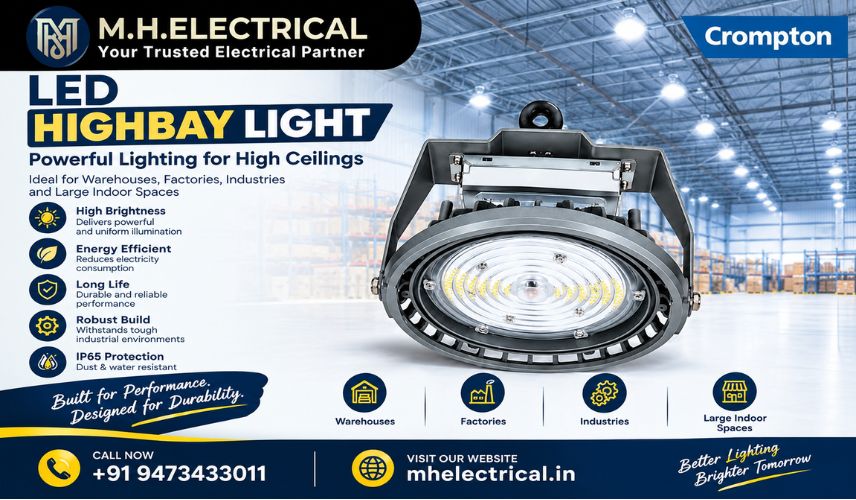
How Proper Lighting Improves Productivity in Large Indoor Spaces
Lighting plays an important role in the performance, safety, and efficiency of large indoor spaces. Warehouses, factories, workshops, manufacturing units, logistics centres, and commercial buildings require suitable illumination to support daily operations. Choosing the right lighting equipment and installing it at the correct height can make a significant difference in how effectively an area is illuminated. This is why selecting the appropriate LED High Bay Light and determining its mounting height should be an essential part of every industrial lighting project.
An LED High Bay Light is designed to illuminate areas with high ceilings, where conventional lighting solutions may not provide sufficient brightness or uniform light distribution. However, installing a high bay fixture too high or too low can affect its performance. The ideal height depends on ceiling height, floor area, required illumination, beam angle, fixture wattage, and the nature of the work performed below.
For businesses planning a new lighting installation or upgrading an existing system, understanding the relationship between mounting height and light output helps achieve better illumination while managing electricity consumption. M.H. Electrical offers Crompton LED High Bay Light options suitable for different industrial and commercial lighting requirements, making it easier to explore solutions for various applications.
What Is the Best Height for an LED High Bay Light?
The best height for an LED High Bay Light generally falls between 6 and 15 metres, depending on the building, lighting design, and fixture specifications. In some specialised industrial facilities, high bay fixtures may be installed at greater heights when the equipment and lighting calculations support that arrangement.
There is no single mounting height that works for every application. A warehouse with tall storage racks has different lighting requirements from a factory floor, sports facility, or commercial workshop. Therefore, the height should be selected according to the area that needs illumination and the light level required for the activities taking place there.
The following table provides general mounting-height guidance for planning purposes.
| Mounting Height | Typical Applications |
|---|---|
| 4–6 metres | Small workshops, garages, and medium-height commercial spaces |
| 6–8 metres | Workshops, production areas, and small warehouses |
| 8–10 metres | Industrial buildings, warehouses, and manufacturing facilities |
| 10–12 metres | Large warehouses and high-ceiling industrial spaces |
| 12–15 metres | Tall industrial buildings and selected logistics facilities |
| Above 15 metres | Specialised industrial applications requiring a detailed lighting design |
These heights are indicative rather than fixed installation rules. The appropriate LED High Bay Light mounting height must be determined by considering the fixture’s photometric data, lumen output, beam distribution, spacing, and required illuminance.
Why Is Mounting Height Important for an LED High Bay Light?
The mounting height of an LED High Bay Light directly affects how light reaches the working surface. Even a powerful fixture may fail to provide satisfactory illumination when installed incorrectly or selected without considering the building layout.
1. Achieving Uniform Light Distribution
Uniform lighting is essential in warehouses, factories, and production areas. Employees need to see equipment, materials, walkways, and work surfaces clearly. If an LED High Bay Light is installed too high without sufficient output, the floor may receive inadequate illumination.
Similarly, fixtures installed too low may create concentrated bright areas while leaving darker spaces between fittings. Proper mounting height, suitable beam angles, and correct fixture spacing help distribute light more evenly throughout the building.
2. Reducing Glare
Glare can make it difficult for workers to see comfortably, especially when they regularly look towards overhead lights. An LED High Bay Light should be positioned to provide suitable illumination without producing unnecessary visual discomfort.
The solution involves more than simply increasing or decreasing the mounting height. Lens design, beam angle, fixture orientation, reflective surfaces, and the viewing direction of workers must also be considered.
3. Improving Workplace Safety
Industrial environments often contain machinery, moving equipment, storage racks, and pedestrian routes. Poor illumination can make obstacles, labels, and changes in floor level harder to identify.
Installing an appropriate LED High Bay Light at a suitable height supports visibility across working areas. Facilities should also consider emergency lighting and any special illumination requirements associated with their operations.
4. Supporting Energy Efficiency
Energy efficiency depends on selecting the right fixture and designing the lighting layout correctly. A suitable LED High Bay Light can provide the required illumination while consuming less electricity than many older lighting technologies.
However, installing an undersized light at excessive height may lead to additional fixtures or higher wattage being required. A lighting calculation helps balance fixture output, mounting height, spacing, and energy consumption.
How to Choose the Correct LED High Bay Light Height
Choosing the right installation height requires evaluating several factors together. The following considerations help businesses identify an appropriate lighting solution for their buildings.
1. Consider the Ceiling Height
Ceiling height is the starting point when planning an LED High Bay Light installation. Buildings with ceilings of 6–8 metres may require a different combination of wattage and beam distribution from facilities with ceilings above 12 metres.
For example, a 100W fixture may be appropriate for certain medium-height applications, depending on its lumen output and the required lighting level. A taller facility may need a higher-output fixture or a different number and arrangement of lights.
The wattage alone does not determine suitability. Always check the actual lumen output and photometric information of the proposed LED High Bay Light.
2. Check the Required Brightness
Different work environments require different illumination levels. General storage areas may have lower requirements than detailed assembly stations, inspection areas, or precision manufacturing zones.
Illuminance is measured in lux, which represents the amount of light falling on a surface. The target lux level should be established according to the task, applicable standards, and workplace requirements.
A lighting designer can calculate the number of LED High Bay Light fixtures needed to meet the required lux level while maintaining reasonably uniform illumination.
3. Understand Beam Angle
Beam angle determines how broadly light spreads from a fixture. A narrower beam concentrates light over a smaller area, while a wider beam distributes light across a broader space.
At greater mounting heights, the beam angle becomes particularly important because the light must cover the required working area from farther away.
A suitable LED High Bay Light beam angle helps balance brightness, coverage, and uniformity. The final selection should be based on the fixture’s photometric distribution rather than beam angle alone.
4. Evaluate Fixture Spacing
Mounting height and spacing work together. Even a high-output LED High Bay Light can produce uneven illumination if fixtures are placed too far apart.
When planning a lighting layout, consider the distance between fixtures, distance from walls, aisle positions, storage racks, and the height of work surfaces. A photometric layout can help identify dark spots and excessive overlap before installation.
5. Account for the Working Environment
Dust, heat, moisture, and other environmental conditions can influence fixture selection. Manufacturing plants and warehouses may require luminaires with suitable ingress protection, thermal performance, and construction materials.
A suitable LED High Bay Light should be selected according to the conditions at the installation site, not only its mounting height and wattage.
Recommended LED High Bay Light Wattage for Different Heights
Wattage can help narrow down the available options, but it should not be treated as a direct measurement of brightness. Two LED High Bay Light models with the same wattage may have different lumen outputs and light distributions.
The following table is a preliminary selection guide rather than a substitute for a lighting calculation.
| Approximate Mounting Height | Wattage Range to Consider | Potential Applications |
|---|---|---|
| 4–6 metres | 50W–100W | Small workshops and compact commercial spaces |
| 6–8 metres | 100W–150W | Medium workshops and production areas |
| 8–10 metres | 100W–200W | Warehouses and industrial floors |
| 10–12 metres | 150W–250W | Large storage and manufacturing facilities |
| 12–15 metres | 200W–300W or suitable higher-output options | Tall industrial buildings |
The final wattage depends on the required lux level, fixture efficiency, mounting arrangement, reflectance of walls and ceilings, and operating conditions. A well-designed lighting system may use several lower-wattage fittings instead of a smaller number of high-wattage units.
Crompton LED High Bay Light Products Available at M.H. Electrical
M.H. Electrical supplies lighting products for industrial and commercial applications, including Crompton LED High Bay Light models. Different power ratings and product configurations can help businesses evaluate lighting solutions according to their ceiling height, installation conditions, and operational needs.
When choosing a model, buyers should compare the actual product specifications, including lumen output, efficacy, colour temperature, beam angle, IP rating, surge protection, and warranty.
1. Crompton EIP LED High Bay Light
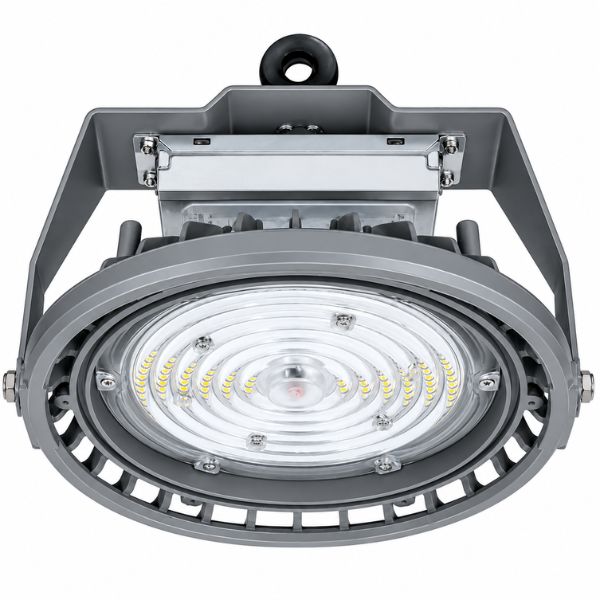
The Crompton EIP LED High Bay Light range is an option to consider when planning industrial lighting installations that require dependable overhead illumination. EIP models are available in different power categories, including 100W, 120W, 150W, 200W, and 250W options in the product range.
A 100W or 120W LED High Bay Light may be worth evaluating for suitable medium-height spaces, while 150W and 200W versions may be considered for larger areas or applications requiring higher light output. The 250W option may be useful for selected industrial installations with greater illumination demands.
These are preliminary application suggestions. The actual suitability of each EIP model depends on its specific lumen output and photometric data.
Before selecting an EIP fixture, assess the ceiling height, the size of the area, the required lux level, and the position of machinery or storage racks. A proper layout helps determine the number of lights needed and their spacing.
2. Crompton CIP LED High Bay Light
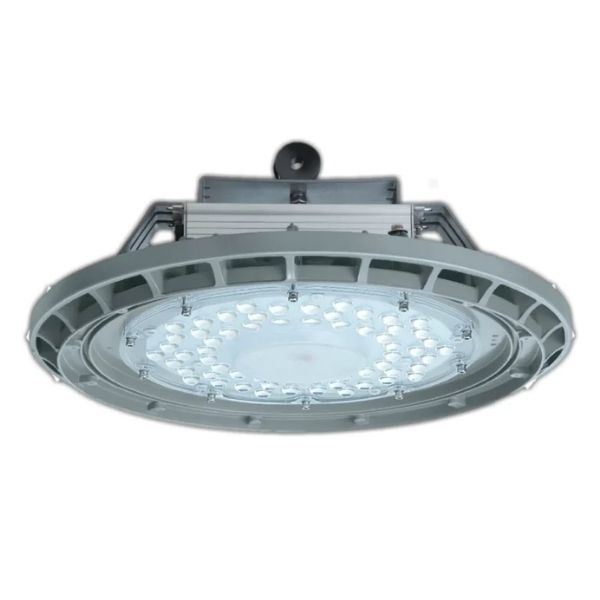
The Crompton CIP LED High Bay Light range provides additional options for industrial and commercial lighting projects. Depending on the available model and its specifications, these fixtures can be evaluated for warehouses, workshops, manufacturing units, and other high-ceiling environments.
The range includes power categories such as 100W, 120W, 150W, 200W, and 250W, subject to the particular product listing. The correct model should be selected by comparing its rated output and installation requirements rather than choosing wattage based on ceiling height alone.
A 150W CIP LED High Bay Light, for instance, should be assessed according to its published lumen output, beam distribution, and intended mounting conditions. The lighting designer can then determine whether one fixture provides sufficient coverage or whether additional fittings are required.
For projects involving high storage racks, the lighting layout should also account for aisle visibility and the possibility of shadows created by stored materials.
3. Crompton EIP-345 200W LED High Bay Light
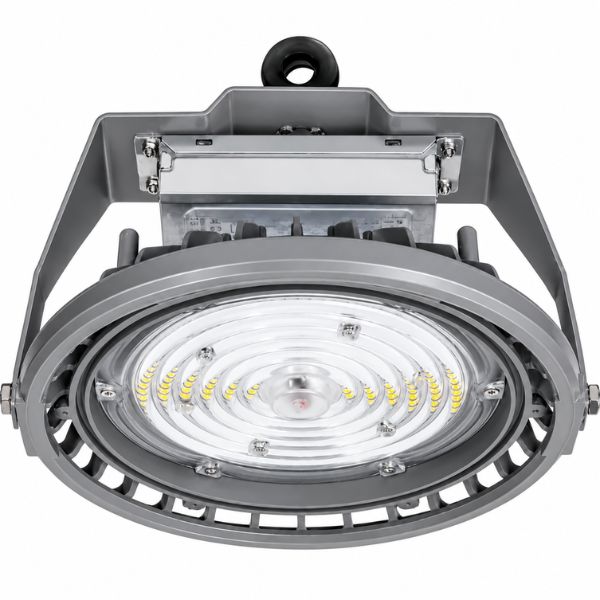
The Crompton EIP-345 200W LED High Bay Light is another option to consider for industrial lighting requirements. This model is listed with a luminous efficacy of up to 130 lumens per watt.
At that efficacy, a 200W fixture would correspond to approximately 26,000 lumens if the rated efficacy applies to the complete fixture output. The exact published lumen rating should always be confirmed from the relevant product documentation.
This level of output may make the EIP-345 worth evaluating for selected large workshops, warehouse spaces, and manufacturing areas with higher illumination requirements.
However, a 200W LED High Bay Light is not automatically suitable for every ceiling above a particular height. The designer must consider the required lux level, mounting height, spacing, beam angle, and number of fittings.
For best results, review the product photometric data and calculate the expected illumination on the working plane before finalising the installation.
4. Crompton TIP-334-100 LED High Bay Light
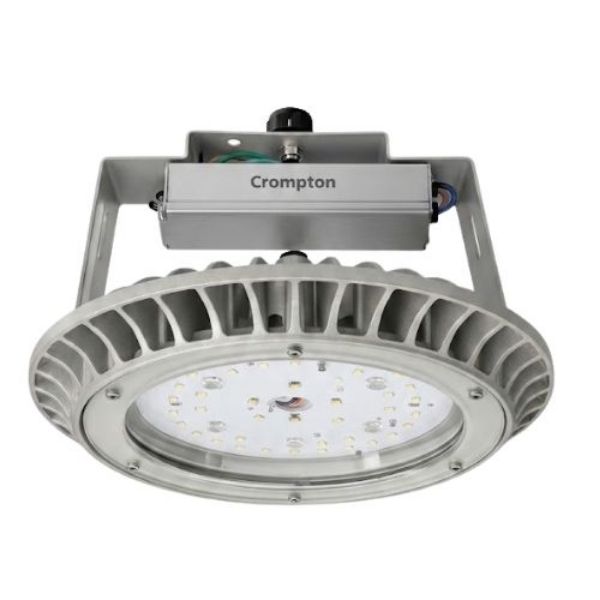
The Crompton TIP-334-100 is a 100W LED High Bay Light designed for applications where its output and construction match the site’s requirements.
The model specifications include a 5700K colour temperature, luminous efficacy of up to 130 lumens per watt, a 60-degree beam angle, an IP66 rating, an aluminium body, and toughened glass. It also includes a power factor of at least 0.95, 5kV surge protection, and a two-year warranty.
With efficacy of up to 130 lumens per watt, the theoretical output at 100W is approximately 13,000 lumens, subject to the model’s actual rated output.
Its 60-degree beam angle is an important consideration when determining mounting height and spacing. A relatively focused beam may suit certain layouts, but coverage must be checked to ensure the installation does not leave excessive dark areas.
The TIP-334-100 can be evaluated for appropriate industrial spaces where its light distribution, environmental rating, and output meet the project requirements. Always confirm the manufacturer’s installation guidance before mounting the fixture.
Choosing Between 100W, 150W, and 200W LED High Bay Lights
Selecting the correct wattage is easier when the lighting requirements are understood.
When to Consider a 100W LED High Bay Light
A 100W LED High Bay Light may be suitable for medium-height areas, smaller workshops, or specific zones that do not require extremely high illumination. It can also be useful where multiple fixtures are installed in a carefully designed layout.
For example, the Crompton TIP-334-100 can be evaluated for suitable applications because of its 100W rating and specified 60-degree beam angle.
When to Consider a 150W LED High Bay Light
A 150W LED High Bay Light may be considered for larger working areas or locations requiring greater output than a lower-wattage fixture provides. The Crompton CIP 150W option is worth evaluating against the required lux level and product specifications.
The final decision should account for the ceiling height, spacing, and layout of the facility.
When to Consider a 200W LED High Bay Light
A 200W LED High Bay Light may be appropriate for selected large warehouses, manufacturing units, and industrial buildings with greater illumination demands. The Crompton EIP-345 200W model offers one option to investigate.
However, a higher wattage does not automatically guarantee better lighting. Correct fixture placement, suitable beam distribution, and the required light level remain essential.
Common Mistakes to Avoid When Installing an LED High Bay Light
Installing Fixtures Without Lighting Calculations
Choosing fittings based only on room dimensions or wattage can result in poor coverage. Lighting calculations help establish the number of fixtures and their placement.
Mounting Lights Too High or Too Low
Excessive mounting height can reduce illumination on working surfaces, while overly low mounting may cause glare or uneven brightness. Follow the manufacturer’s mounting guidance and the lighting design.
Ignoring Beam Angle
A narrow beam and a wide beam distribute light differently. Failing to consider this difference can create bright spots or dark zones.
Overlooking Maintenance Requirements
Dust accumulation, environmental exposure, and the condition of electrical components can affect lighting performance over time. Select products suitable for the site and follow the recommended inspection and maintenance schedule.
Choosing Only by Purchase Price
A lower purchase price does not necessarily mean a lower overall cost. Compare energy consumption, expected service life, warranty, maintenance requirements, and the illumination achieved by the complete installation.
How to Calculate the Number of LED High Bay Lights Required
A preliminary estimate can help establish the scale of a lighting project. A common lumen-method calculation is:
Number of fixtures = (Area × Required Lux) ÷ (Lumens per Fixture × Utilisation Factor × Maintenance Factor)
For example, consider a warehouse measuring 20 metres by 30 metres, with a target illuminance of 200 lux. Its floor area is 600 square metres, so the required light reaching the working plane is 120,000 lumen-lux units, or 120,000 lumens of useful illumination across the area.
Assume each proposed LED High Bay Light produces 26,000 lumens, with a utilisation factor of 0.70 and a maintenance factor of 0.80.
The estimated number of fixtures would be:
600 × 200 ÷ (26,000 × 0.70 × 0.80) = approximately 8.24 fixtures.
This preliminary calculation suggests that about nine fixtures may be needed. However, the actual layout could require more fixtures to achieve uniform lighting, particularly where there are high racks, obstructions, or specialised work areas.
The example is illustrative only. A professional lighting design should confirm the required lux level, fixture photometry, spacing, uniformity, glare, and applicable workplace standards.
Why Choose M.H. Electrical for Crompton LED High Bay Light Requirements?
Selecting a suitable LED High Bay Light involves understanding the building’s needs and matching them with the right product. M.H. Electrical helps customers explore Crompton lighting options for different industrial and commercial applications.
Whether a project requires a 100W, 150W, or 200W LED High Bay Light, reviewing the individual model specifications is an important step in the selection process. Customers should compare luminous efficacy, output, colour temperature, beam angle, ingress protection, surge protection, and warranty before making a decision.
For industrial projects, it is also helpful to prepare basic information about the site, including ceiling height, floor dimensions, working activities, operating hours, and any environmental challenges. These details support a more informed product selection.
A carefully planned lighting system can improve visibility, support safer working conditions, and help businesses manage energy use. The right combination of mounting height, fixture output, and spacing is more valuable than selecting a product on wattage alone.
Final Thoughts on the Best Height for an LED High Bay Light
The best height for an LED High Bay Light depends on the ceiling, the application, the desired illumination, and the specifications of the selected fixture. Many industrial installations use mounting heights between 6 and 15 metres, but the ideal arrangement should always be verified through lighting calculations and manufacturer guidance.
Crompton EIP, CIP, EIP-345 200W, and TIP-334-100 models provide options to evaluate for different lighting requirements. Each product should be matched to the actual site conditions rather than assigned a universal mounting height.
By considering ceiling height, lux levels, beam angle, fixture spacing, and environmental conditions, businesses can develop an effective lighting plan for warehouses, factories, workshops, and other high-ceiling spaces. A properly selected and installed LED High Bay Light system helps deliver practical illumination while supporting the long-term performance of the facility.


