


Why Proper Industrial Lighting Matters
Lighting is one of the most important elements in any warehouse, factory, manufacturing unit, or large commercial facility. A well-designed lighting system does more than simply make a space brighter. It helps workers see products, machinery, storage racks, pathways, labels, and workstations clearly while creating a more comfortable and productive working environment.
In large industrial buildings, lighting requirements are often more demanding because ceilings can be several metres high and floor areas can extend across thousands of square feet. Ordinary ceiling lights may not provide sufficient coverage from such heights. Businesses therefore need lighting solutions that can deliver strong illumination over large areas while keeping energy consumption and maintenance requirements under control.
With the development of LED technology, industrial lighting has become more efficient and flexible. LED high bay lights are now widely considered for warehouses, factories, workshops, production facilities, logistics centres, and other high-ceiling applications.
Understanding High Bay Lighting
High bay lighting refers to lighting designed for areas where fixtures need to be installed at considerable heights. These lights are engineered with suitable lumen output and optical distribution so that useful illumination reaches the floor and working surfaces.
What Makes a High Bay Light Different?
A high bay light is designed differently from a standard LED ceiling light. When a fixture is installed high above the floor, the light needs to travel a greater distance before reaching the working area.
For this reason, high bay fixtures generally focus on:
- High lumen output
- Efficient LED performance
- Suitable beam distribution
- Reliable thermal management
- Durable construction
- Long operating life
- Industrial protection ratings
The right combination of these features can provide more effective illumination than simply installing a large number of ordinary lights.
Why Warehouses Require Specialized Lighting
Warehouses can have tall ceilings, narrow aisles, large storage racks, loading areas, packing stations, and open floor spaces. Each area may have different lighting requirements.
Better Visibility Between Storage Racks
Storage racks can create shadows when lighting is poorly positioned. A suitable high bay lighting layout can help distribute illumination across aisles and storage areas.
Good visibility is particularly useful when employees need to identify products, read labels, move materials, or operate equipment.
Lighting Large Open Areas
Large warehouses may require lighting across substantial floor areas. High-output LED fixtures can provide broad illumination while reducing the number of individual fixtures required compared with lower-output lighting systems.
Supporting Loading and Packing Areas
Loading bays and packing zones can also benefit from consistent illumination. Workers need adequate visibility when checking products, preparing shipments, or moving goods.
LED High Bay Lights for Factories
Factories and manufacturing units have their own lighting challenges. Production areas may contain machinery, assembly lines, conveyors, tools, workstations, and inspection areas.
Supporting Production Operations
Good lighting can make work areas easier to see and help employees perform visual tasks more comfortably. The required illumination level depends on the nature of the work being performed.
For general production areas, a balanced lighting layout can help provide consistent illumination across the floor.
Machinery and Equipment Areas
Machinery can create shadows or obstruct light. High bay lights should therefore be positioned according to the actual layout of the facility rather than simply being installed at equal distances without considering obstacles.
Inspection and Quality Control
Some manufacturing processes involve detailed visual inspection. In such areas, businesses should consider factors such as illumination level, colour rendering, glare, and uniformity when designing the lighting system.
Major Benefits of LED High Bay Lights
High Energy Efficiency
Energy consumption is an important concern for industrial facilities because lights may operate for many hours every day.
LED technology can provide high light output with comparatively efficient electrical consumption. The actual energy savings depend on the existing lighting system, operating schedule, fixture efficiency, and lighting design.
Businesses replacing older lighting systems should compare the total wattage of the existing installation with the proposed LED system rather than looking at individual fixture wattage alone.
Long Service Life
LED high bay lights are generally designed for long operating life. Depending on the product and operating conditions, many commercial LED fixtures are rated for tens of thousands of hours.
A long service life can be especially valuable when fixtures are installed at significant heights because replacing them may require lifting equipment and maintenance personnel.
Lower Maintenance Requirements
Traditional lamps may require frequent replacement, whereas long-life LED fixtures can reduce replacement frequency.
This can help reduce maintenance interruptions in warehouses and factories where lighting is an important part of daily operations.
Instant Light
LED fixtures generally provide illumination immediately after switching on. This can be useful in industrial environments where lights are controlled through switches, timers, sensors, or automated systems.
Consistent Illumination
A properly designed LED high bay system can provide more uniform illumination across large areas. Optical designs can be selected according to ceiling height, floor layout, rack configuration, and required coverage.
How to Select the Right LED High Bay Light
Choosing an industrial lighting fixture should involve more than selecting a wattage.
Consider the Ceiling Height
The first factor is the mounting height.
A warehouse with a moderate ceiling height may require a different lighting solution from a facility with a very tall ceiling. As mounting height increases, the optical distribution and lumen output become increasingly important.
Before purchasing, measure the approximate height from the floor to the proposed fixture mounting position.
Check Lumen Output
Lumens indicate the amount of light produced by a fixture, while watts indicate electrical power consumption.
Two lights with similar wattage can have different lumen outputs. Therefore, businesses should compare lumen output and luminous efficacy when selecting high bay lighting.
Choose the Correct Beam Angle
Beam angle determines how widely light spreads from the fixture.
Wide Beam
A wide beam can be suitable for large open areas where broad illumination is required.
Narrow Beam
A narrower beam may be useful where light needs to be concentrated, such as certain high-ceiling applications or specific aisle layouts.
The ideal beam angle depends on mounting height, fixture spacing, rack arrangement, and desired illumination.
Check IP Rating
Warehouses and factories can have different environmental conditions. Some areas may experience dust, moisture, humidity, or airborne particles.
The IP rating indicates the level of protection provided by the enclosure against solids and water under defined test conditions.
For industrial applications, products with ratings such as IP65 or IP66 may be considered where the environment requires additional protection. However, the exact requirement should always be matched with the manufacturer’s specifications.
Popular LED High Bay Light Options for Industrial Applications
Different warehouses, factories, workshops, and manufacturing facilities have different lighting requirements. The appropriate high bay light depends on factors such as ceiling height, floor area, required illumination, beam angle, operating hours, and installation environment.
Crompton 100W LED High Bay Light
The Crompton 100W LED High Bay Light can be considered for warehouses, workshops, storage areas, and industrial spaces where reliable overhead illumination is required. Its 100W configuration can be suitable for applications with moderate lighting requirements.
It can be particularly useful when businesses are looking for an efficient industrial lighting option without selecting a higher-wattage fixture than the application requires. The final number of fixtures should be determined according to the area, mounting height, and desired illumination.
Crompton 120W LED High Bay Light
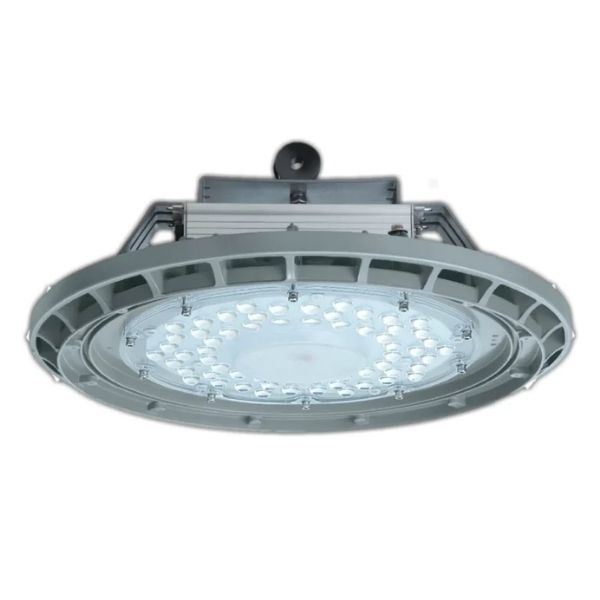
The Crompton 120W LED High Bay Light is another option for warehouses, factories, production areas, workshops, and commercial facilities with elevated ceilings. Its 120W configuration provides a higher power level than the 100W option and can be considered for areas requiring greater light output.
When selecting this type of fixture, businesses should evaluate lumen output and beam distribution alongside wattage to ensure the light is appropriate for the intended installation.
Crompton 150W LED High Bay Light
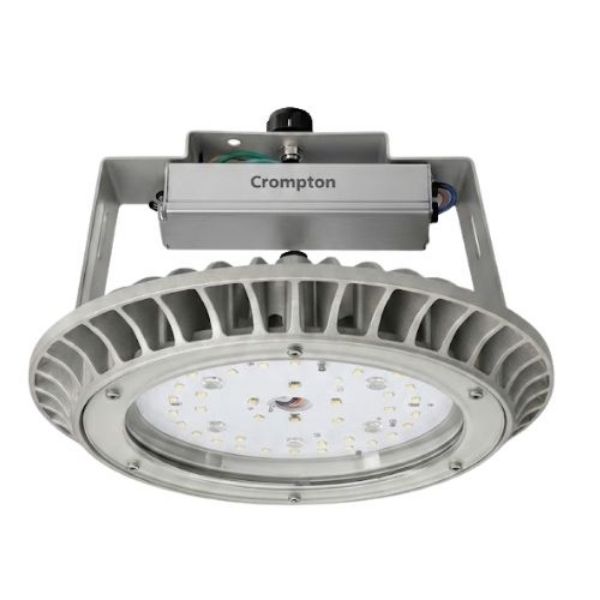
For larger industrial spaces or applications requiring stronger illumination, the Crompton 150W LED High Bay Light can be considered. It can be suitable for manufacturing units, large warehouses, production floors, logistics facilities, and high-ceiling workshops.
The 150W option may be particularly useful where a higher-output fixture is required. However, fixture spacing and mounting height should still be considered to achieve consistent illumination throughout the working area.
Crompton 200W LED High Bay Light
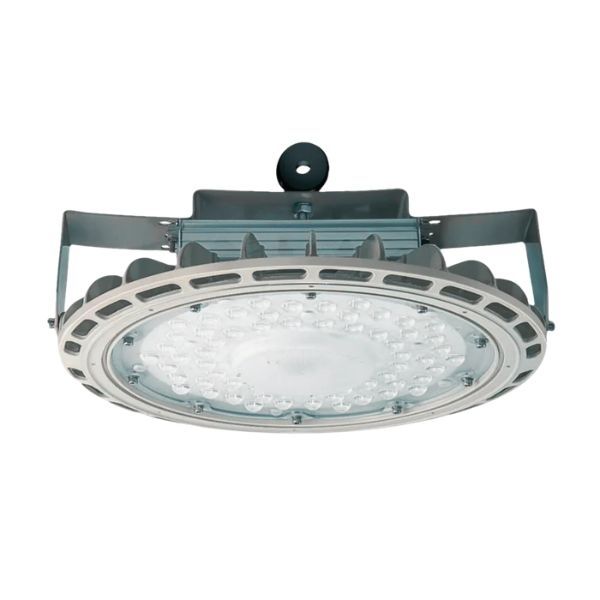
The Crompton 200W LED High Bay Light is suitable for applications where higher light output is required across larger industrial areas. It can be considered for large warehouses, factories, manufacturing plants, logistics centres, and other high-ceiling facilities.
A 200W fixture should not be selected simply because it has a higher wattage. Businesses should compare its lumen output, efficacy, beam angle, mounting height, and required illumination before finalising the lighting design.
Crompton 120W LED High Bay Light CIP-328-120-57-60D-HL2-LM-NGG
The Crompton 120W LED High Bay Light CIP-328-120-57-60D-HL2-LM-NGG is a specific industrial high bay model that can be considered for high-ceiling applications.
Its listed specifications include 120W power, 120 lm/W luminous efficacy, 5700K CCT, 60° beam spread, IP66 protection, 0.95 power factor, 5KV surge protection, and a 5-year warranty. These features make it an option for industrial environments where efficient illumination, controlled light distribution, and protection against environmental conditions are important considerations.
When comparing these five options, the best choice depends on the actual requirements of the warehouse or factory rather than wattage alone.
Important Specifications to Compare
Before purchasing LED high bay lights, review the technical specifications carefully.
Wattage
Wattage represents the electrical power consumed by the fixture. Common industrial high bay lights are available in several wattage options, allowing businesses to select products according to their lighting requirements.
Luminous Efficacy
Luminous efficacy is generally expressed in lumens per watt. A higher efficacy can indicate that a fixture produces more light from each watt of electricity.
However, efficacy should not be considered independently. Beam distribution, installation height, lighting uniformity, and actual lumen output also matter.
Colour Temperature
Colour temperature affects the appearance of the light. Cool white and daylight-type lighting are commonly considered for industrial environments because they can provide a bright, clear appearance.
The appropriate colour temperature depends on the application and user requirements.
CRI
Colour Rendering Index, or CRI, indicates how accurately colours appear under a light source.
For warehouses where colour identification is not a major concern, a standard industrial CRI may be sufficient. Manufacturing, inspection, and quality-control applications may require greater attention to colour rendering.
Power Factor
Power factor is another important electrical specification, particularly in large installations where many fixtures operate simultaneously.
Surge Protection
Industrial electrical systems may experience voltage fluctuations and electrical surges. High bay fixtures with suitable surge protection can provide additional protection against certain transient conditions.
Always check the actual surge protection specification provided for the particular product.
Lighting Layout Is Just as Important as Fixture Selection
Even a high-quality LED high bay light may not deliver the desired result if the fixtures are installed incorrectly.
Fixture Spacing
Spacing should be planned according to mounting height, beam angle, lumen output, and required uniformity.
Fixtures installed too far apart may create dark areas, while excessive overlap can result in inefficient use of lighting.
Avoiding Shadows
Machinery, racks, beams, and other structures can block light. The layout should therefore consider physical obstructions.
Lighting Calculations
For larger factories and warehouses, professional lighting calculations can be useful. A lighting plan can estimate fixture quantity, spacing, illumination levels, and uniformity before installation.
This approach can help businesses avoid unnecessary fixture purchases and improve overall lighting performance.
Applications of LED High Bay Lighting
LED high bay fixtures can be used across many industrial and commercial environments.
Warehouses
Suitable for storage facilities, distribution centres, inventory areas, and large logistics warehouses.
Manufacturing Plants
Useful for production floors, assembly areas, machinery zones, and general factory spaces.
Workshops
Large workshops with elevated ceilings can use high bay fixtures for general illumination.
Automobile Facilities
Service centres, manufacturing areas, and large automobile workshops may require powerful overhead lighting.
Logistics Centres
Distribution and logistics facilities often operate for extended hours and have high ceilings, making efficient industrial lighting particularly valuable.
Sports and Large Indoor Facilities
Certain indoor commercial and recreational spaces can also use high-output high bay lighting where ceiling heights and illumination requirements are suitable.
LED High Bay Lights and Energy Savings
One of the strongest reasons businesses consider LED high bay lighting is the potential for lower energy consumption.
Consider a facility operating its lighting system for many hours each day. Even a small reduction in wattage per fixture can become significant when multiplied across dozens or hundreds of lights and long operating hours.
For example, businesses can evaluate:
Annual Energy Consumption = Total Lighting Wattage × Operating Hours × Operating Days
Comparing the existing installation with a proposed LED system can provide a basic estimate of potential energy savings.
However, businesses should also consider the number of fixtures required and whether the new system provides the necessary illumination. The objective should be efficient lighting that meets the application’s requirements, not simply the lowest possible wattage.
Using Sensors and Smart Controls
LED high bay lighting can also be combined with suitable controls.
Occupancy Sensors
Sensors can switch or reduce lighting when areas are unoccupied. This may be useful in selected warehouse aisles, storage areas, or spaces with intermittent activity.
Dimming
Where supported by the fixture, dimming can allow light output to be adjusted according to operating requirements.
Timers
Timers can help control lighting according to scheduled working hours and reduce unnecessary operation outside those periods.
These controls should be selected according to the facility’s workflow and the compatibility of the lighting system.
Common Mistakes When Buying High Bay Lights
Selecting Only by Wattage
Higher wattage does not automatically mean better lighting. Always compare lumen output, efficacy, optics, and application requirements.
Ignoring Mounting Height
A light suitable for a lower ceiling may not provide the same performance at a much higher installation point.
Choosing an Unsuitable Beam Angle
Incorrect beam distribution can cause dark areas or excessive light concentration.
Ignoring Environmental Conditions
Dust and moisture can affect the suitability of a fixture. Select the protection level according to the actual installation environment.
Focusing Only on Purchase Price
The cheapest fixture may not provide the best long-term value. Consider energy consumption, warranty, service life, maintenance, and performance.
Maintenance Tips for LED High Bay Lights
LED high bay lights generally require less maintenance than many traditional lighting technologies, but regular inspection is still recommended.
Fixtures should be checked periodically for dust accumulation, physical damage, loose mounting hardware, and electrical issues.
In dusty environments, cleaning the fixture when necessary can help maintain its optical performance. Maintenance schedules should be based on the actual conditions inside the facility.
Why Businesses in India Are Moving Towards LED Industrial Lighting
India has a wide range of warehouses, factories, manufacturing units, logistics facilities, and commercial buildings where efficient lighting can make a meaningful operational difference.
Long operating hours, maintenance requirements, and the need for better workplace illumination have encouraged many businesses to evaluate LED lighting solutions.
LED high bay lights provide flexibility because they are available in different wattages, lumen outputs, beam angles, mounting options, and protection ratings. This allows businesses to select lighting according to the specific requirements of their facility.
How MH Electrical Can Help With Industrial Lighting
Selecting industrial lighting involves understanding the building layout, ceiling height, application, operating hours, and technical requirements.
MH Electrical provides electrical and lighting products for commercial and industrial applications, including LED lighting solutions from established brands. Businesses can evaluate different high bay lighting options based on wattage, specifications, application requirements, and installation conditions.
The available options, including Crompton 100W, 120W, 150W, and 200W LED high bay lights, can help businesses consider different lighting requirements for warehouses, factories, workshops, and other large indoor spaces.
For a warehouse or factory upgrade, it is advisable to compare the existing lighting system with the proposed LED installation and select products based on performance and long-term value.
Final Thoughts
Efficient lighting is an essential part of modern warehouses and factories. The right lighting system can improve visibility, support industrial operations, reduce unnecessary energy consumption, and minimise maintenance requirements.
When selecting LED high bay lights, businesses should consider ceiling height, lumen output, luminous efficacy, beam angle, IP rating, colour temperature, CRI, power factor, surge protection, operating temperature, warranty, and expected service life.
Rather than choosing a fixture simply because it has a higher wattage or lower price, businesses should focus on the complete lighting requirement. A properly planned LED high bay installation can provide reliable illumination across large industrial spaces while supporting long-term operational efficiency.
For Indian warehouses, factories, workshops, manufacturing plants, and logistics facilities, choosing the right combination of LED high bay light, lighting layout, optical distribution, and control system can make the lighting infrastructure more efficient, practical, and future-ready.


